
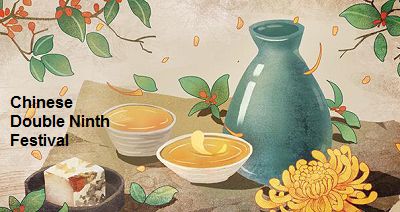
The Double Ninth Festival (重阳节 Chóngyáng jié) also known as Chongyang falls on the 9th day of the 9th month under the lunar calendar and is an ancient memorial festival. It is a day for families to visit the graves of their ancestors to pay their respects, as well as a time for people to climb mountains, eat Chongyang cake, and drink chrysanthemum wine or tea.
The Double Ninth Festival has 2,000 years of history dating back as early as the warring states period (475 – 220 BC), however during this time, it was only celebrated by royal families. Legend has it that a concubine of the Emperor Gaozu from the Han Dynasty (202 – 220 BC) was framed by the Empress, resulting in her maid being banished from the palace. This maid then went on to marry a civilian, revealing to all the commoners that the royal family would wear zhuyu leaves and drink chrysanthemum wine for longevity during the Double Ninth Festival. Just as this news was spread, so too did the tradition of wearing zhuyu leaves and drinking chrysanthemum wine. However, despite the increasing popularity of this tradition, the Double Ninth Festival would only be added to the official list of folk festivals during the Tang dynasty (619 – 906 AD).
Traditions and Customs of the Double Ninth Festival
Hiking
Starting around 2,000 years ago, people used to climb up a platform outside the capital city of Chang’an (now named Xi’an) during the Double Ninth Festival. Due to the timing of the festival (October), this outing would be, for many, the last outing of the year before winter comes (contrastingly in Hong Kong, however, the festival actually coincides with the start of the hiking season). Additionally, according to legend, hiking is supposed to ward off diseases, an added bonus to those family and friends that have a tradition out of trekking various glorious peaks during the day. It’s because of this prevalent tradition that the Double Ninth Festival has earned itself an alternate name – the Height Ascending Festival.
Eating Chongyang Cakes
Ideally nine layered and shaped like a tower, the chongyang cake is a cake that highlights all aspects of the Double Ninth festival. You’ll even be able to find two sheep on the top of the cake that represent the Yang aspect of the festival, since sheep in Chinese is pronounced yang. Also known as as a flower cake, chrysanthemum cake, and five-colour cake, chongyang cakes are regarded as being lucky, and typically consist of rice flour and sugar which are then baked and steamed and decorated with jujube, chestnuts, and almonds. With that said, there is no fixed recipe for chongyang cakes, with many people these days choosing to only have one or two layers decorated with various nuts.
Drinking Chrysanthemum Tea or Wine
As the Festival takes place when chrysanthemum flowers are in full bloom, the consuming and admiring of chrysanthemums has become one of the many festivals many traditions. Traditionalists will typically drink chrysanthemum wine to mark the occasion, though most observers today will opt instead for chrysanthemum tea for its antioxidant properties. The story behind the tradition of drinking chrysanthemum wine goes as follows: it is alleged that the first person to drink chrysanthemum wine during the Double Ninth Festival was the poet Tao Yuan Ming during the Tang Dynasty (317 – 420 AD). Due to his popularity as a poet, people began following in his footsteps and drinking chrysanthemum wine during the Double Ninth Festival grew in popularity.
The Importance of the Zhuyu Plant
Wearing zhuyu (Cornelian cherries) during the Double Ninth Festival first became prevalent during the Tang dynasty (618-907 A.D). People wear zhuyu plants either around their arm or tie a sachet of it around their waist out of the longhand belief that wearing zhuyu helps to ward off evil, disaster, and danger.
Visiting the Elderly
Nine, pronounced jiu, is also the pronunciation for the word long. Due to this, people endow jiu with the meaning of longevity with a person’s life. The double meaning behind the character jiu led to the Double Ninth Festival being crowned a designated senior day in 1989. On the date of the Double Ninth Festival, people visit their relatives or their ancestors’ graves to show respect, making it a suitable day for whole family outings.